4
Cigarettes and Vapes Contain Heavy Metals That Accumulate for Decades
Nicotine gets all the attention. It deserves none of it compared to what else is in the smoke.
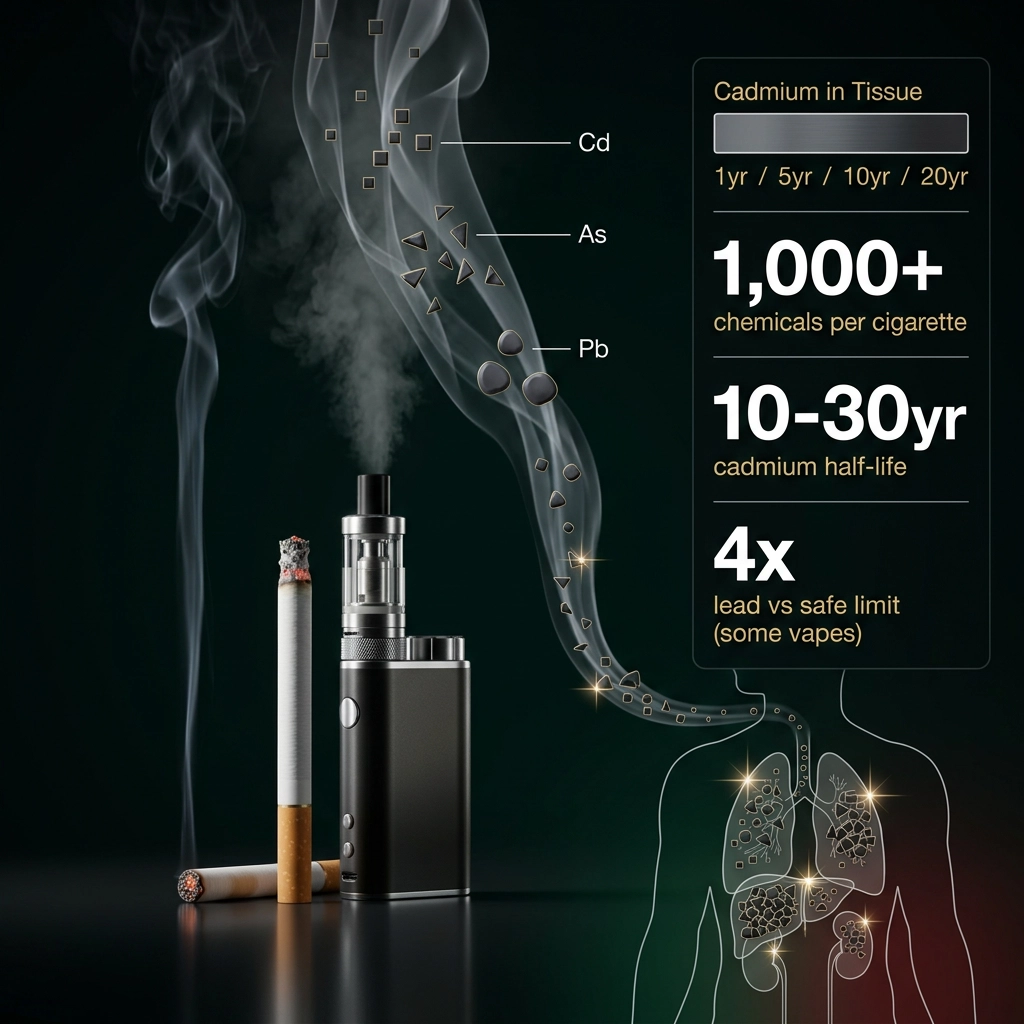
Cigarette smoke contains measurable cadmium, arsenic, lead, and chromium. Cadmium alone accumulates in kidney and liver tissue with a biological half-life measured in decades. Vape aerosol has been shown to contain nickel and lead at concentrations exceeding occupational safety limits in some tested devices.
NAC has documented chelating properties — it binds to certain heavy metals and helps the body excrete them. Research in Environmental Health Perspectives found NAC reduced cadmium-induced oxidative damage and increased urinary excretion of the metal.
If you have been smoking for five or more years, there is cadmium in your kidney tissue right now. That is not alarmism — it is physiology.
The accumulation happening in your organs is also happening in your brain.
Cigarette smoke contains measurable cadmium, arsenic, lead, and chromium. Cadmium alone accumulates in kidney and liver tissue with a biological half-life measured in decades. Vape aerosol has been shown to contain nickel and lead at concentrations exceeding occupational safety limits in some tested devices.
NAC has documented chelating properties — it binds to certain heavy metals and helps the body excrete them. Research in Environmental Health Perspectives found NAC reduced cadmium-induced oxidative damage and increased urinary excretion of the metal.
If you have been smoking for five or more years, there is cadmium in your kidney tissue right now. That is not alarmism — it is physiology.
The accumulation happening in your organs is also happening in your brain.
5
The Brain Fog You've Normalized Is Not Normal
You've adapted to it. That's the problem with gradual cognitive decline — you adjust your baseline and stop noticing.
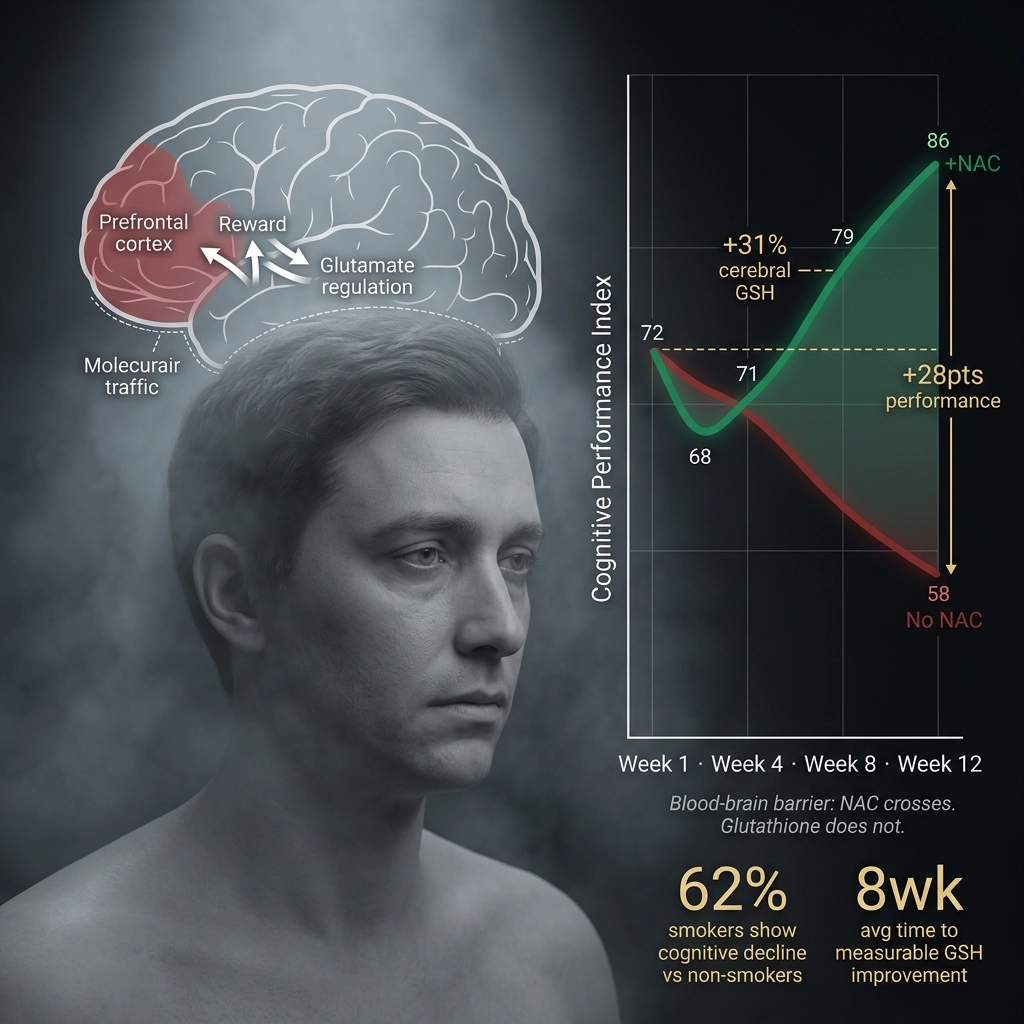
Chronic smoking and alcohol use both reduce cerebral glutathione. When it drops, glutamate regulation becomes dysregulated — and excess glutamate is directly neurotoxic. In daily life this looks like reduced concentration, mood instability, slightly elevated anxiety, and a persistent mental flatness that smokers report at significantly higher rates than non-smokers.
NAC is one of the few compounds that crosses the blood-brain barrier efficiently and raises cerebral glutathione. A trial in Neuropsychopharmacology found measurable improvements in glutamate regulation and cognitive performance markers in NAC-supplemented subjects.
The effects on your brain are insidious. The effects on your cardiovascular system are quieter still.
Chronic smoking and alcohol use both reduce cerebral glutathione. When it drops, glutamate regulation becomes dysregulated — and excess glutamate is directly neurotoxic. In daily life this looks like reduced concentration, mood instability, slightly elevated anxiety, and a persistent mental flatness that smokers report at significantly higher rates than non-smokers.
NAC is one of the few compounds that crosses the blood-brain barrier efficiently and raises cerebral glutathione. A trial in Neuropsychopharmacology found measurable improvements in glutamate regulation and cognitive performance markers in NAC-supplemented subjects.
The effects on your brain are insidious. The effects on your cardiovascular system are quieter still.

6
Your Blood Vessels Are Silently Stiffening - Years Before Any Symptom
There will be no warning sign. That is the nature of endothelial damage.
Every cigarette triggers an acute inflammatory response in the endothelium — the inner lining of your blood vessels. Adhesion molecules form, micro-inflammation begins, and arterial stiffening progresses. By the time symptoms appear, the damage has been compounding for years.
NAC reduces circulating homocysteine — strongly associated with cardiovascular risk — and directly reduces endothelial oxidative stress. A trial in the Journal of the American College of Cardiology found NAC significantly improved endothelial function markers in smokers. Consistent daily use means consistent support for a vascular system that is consistently under attack.
All of this accumulates at the macro level. What happens at the cellular level is the foundation beneath all of it.
Every cigarette triggers an acute inflammatory response in the endothelium — the inner lining of your blood vessels. Adhesion molecules form, micro-inflammation begins, and arterial stiffening progresses. By the time symptoms appear, the damage has been compounding for years.
NAC reduces circulating homocysteine — strongly associated with cardiovascular risk — and directly reduces endothelial oxidative stress. A trial in the Journal of the American College of Cardiology found NAC significantly improved endothelial function markers in smokers. Consistent daily use means consistent support for a vascular system that is consistently under attack.
All of this accumulates at the macro level. What happens at the cellular level is the foundation beneath all of it.
7
Every Year of Smoking Writes Something Into Your Cells That Compounds Over Time
This is the long game, and most people are not thinking about it.
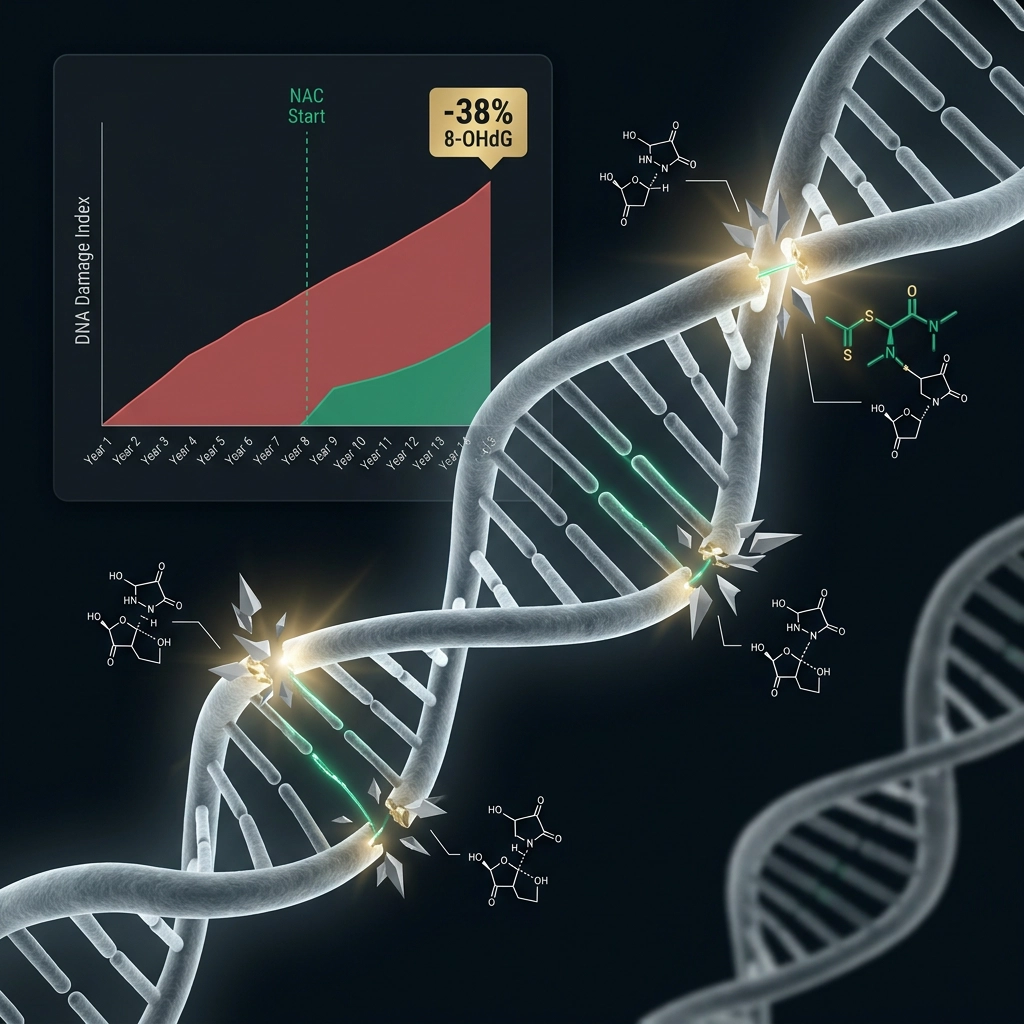
Oxidative stress causes DNA strand damage — direct chemical modification of your genetic material. Your body has repair mechanisms for this. Those mechanisms require glutathione. When glutathione is chronically depleted, the repair rate slows and unrepaired DNA lesions accumulate. Over decades, this is one of the primary mechanisms through which chronic toxin exposure increases disease risk.
A study in Mutation Research found NAC supplementation reduced markers of oxidative DNA damage in smokers over eight weeks — measured directly in blood cells, dose-dependent and statistically significant.
You cannot undo what has already happened. But you can change the rate at which it continues to.
Oxidative stress causes DNA strand damage — direct chemical modification of your genetic material. Your body has repair mechanisms for this. Those mechanisms require glutathione. When glutathione is chronically depleted, the repair rate slows and unrepaired DNA lesions accumulate. Over decades, this is one of the primary mechanisms through which chronic toxin exposure increases disease risk.
A study in Mutation Research found NAC supplementation reduced markers of oxidative DNA damage in smokers over eight weeks — measured directly in blood cells, dose-dependent and statistically significant.
You cannot undo what has already happened. But you can change the rate at which it continues to.




What This All Adds Up To
NAC has been used clinically for over 50 years, studied in thousands of trials, and dosed at 600 to 1800mg daily with a well-established safety profile. It does not cancel out smoking, vaping, or drinking. It addresses the specific biological mechanisms through which they damage you — all through one central mechanism: restoring glutathione.
The people who need to know about this are not the ones already taking a dozen supplements. They are the people who smoke on weekends, drink casually, vape because it seemed safer, and have never once thought about what glutathione is. The science has been there for decades. Most people just haven't been told about it in plain language.
The people who need to know about this are not the ones already taking a dozen supplements. They are the people who smoke on weekends, drink casually, vape because it seemed safer, and have never once thought about what glutathione is. The science has been there for decades. Most people just haven't been told about it in plain language.
60-day money back guarantee if you do not see results